Ask five contractors which fire code governs your building and you'll often get five different answers — usually all delivered with total confidence. It's not that anyone is being careless; it's that India's fire safety compliance landscape genuinely has two layers, and most projects sit somewhere in the overlap between them. Get the answer wrong and you either under-spec your system and fail inspection, or over-spec it and pay for equipment your project never needed.
What the National Building Code Actually Covers
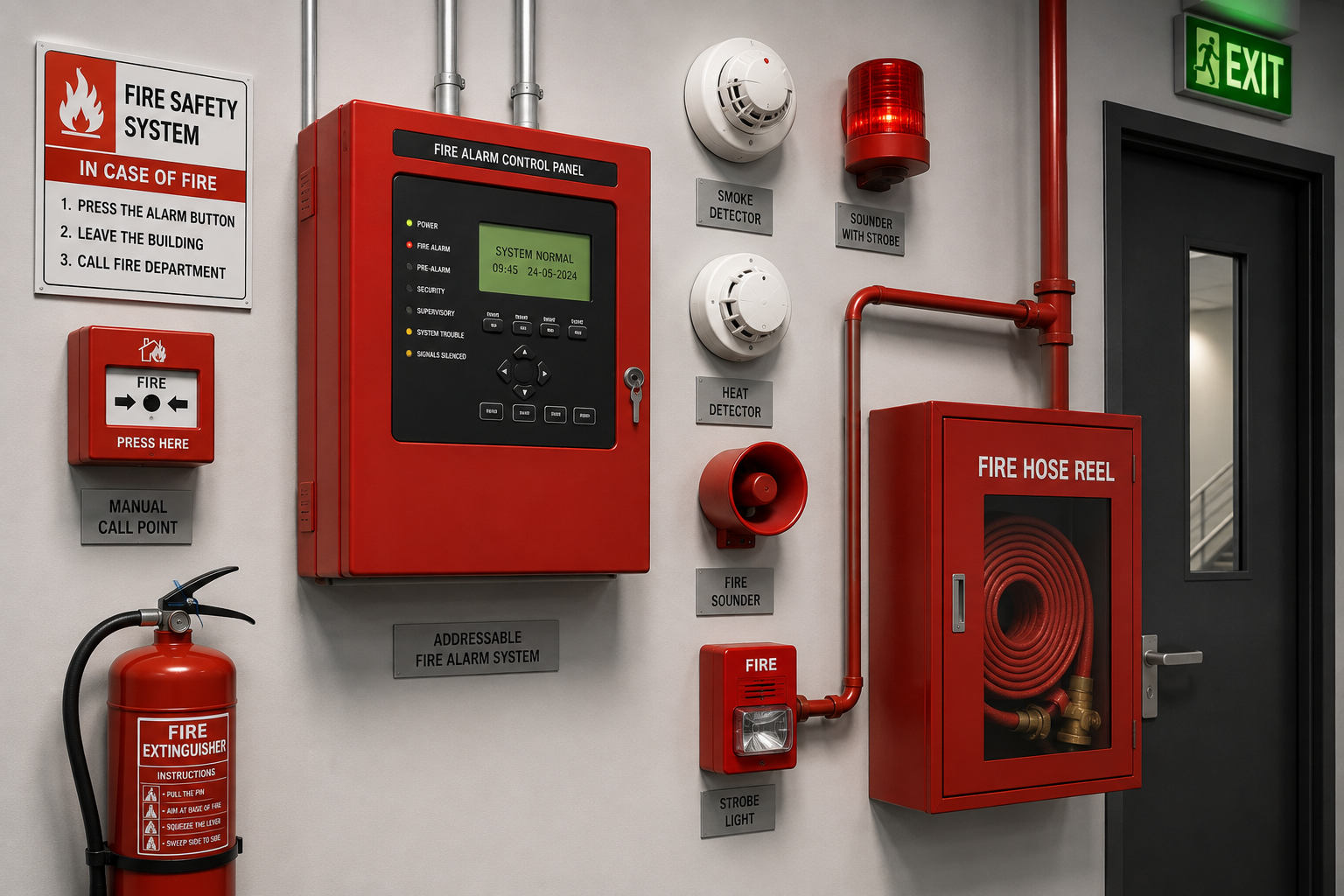
The National Building Code of India (NBC) is the baseline. It's issued by the Bureau of Indian Standards and referenced directly by most state fire departments when they issue a Fire NOC (No Objection Certificate). NBC Part 4 covers fire and life safety broadly — means of escape, fire resistance of structural elements, minimum detector and hydrant spacing, and staircase widths based on occupant load. If your project only needs local fire department sign-off, NBC compliance is very often where the conversation starts and ends.
Where NFPA Gets Layered on Top
NFPA — the US-based National Fire Protection Association — isn't a legal requirement in India, but it shows up constantly on corporate, hospitality, and healthcare projects for a specific reason: insurance and international brand standards. A global hotel chain's brand manual will often mandate NFPA 72 for fire alarm design regardless of what NBC requires locally, because their insurer underwrites the property against that standard worldwide. The same happens with data centers and multinational corporate campuses, where NFPA 75 or NFPA 2001 governs suppression system selection around sensitive electronics.
The Overlap — And Where the Two Actually Conflict
Most of the time, NBC and NFPA point in the same direction, just with different numbers. Detector spacing, for instance, is specified differently under each — NFPA 72 generally calls for tighter smoke detector coverage than NBC's minimum. Egress width calculations differ too, with NFPA 101 often demanding wider stairwells for the same occupant load than NBC's formula produces. When both apply — which happens on nearly every hospitality and corporate project we design — the practical rule is simple:
Design to whichever standard is stricter on that specific parameter, then document both.
How We Determine Which Standard Applies to Your Project
Before we size a single detector, we ask three questions:
- Who is your Fire NOC authority, and what do they explicitly require?
- Does your insurer, franchise agreement, or brand standard specify NFPA compliance?
- Is there an international certification — like LEED, or a hotel brand's own audit — tied to the property?
The answers usually make the applicable standard obvious — and where there's genuine overlap, we design to the tighter of the two so the system passes every audit it will ever face, not just the first one.
The Takeaway
Compliance isn't a box you tick once at handover — it's audited again at renewal, at insurance review, and after every incident investigation. Getting the standard right at the design stage is far cheaper than retrofitting it later. If you're not sure which code actually governs your building, that's exactly the conversation to have with your fire safety contractor before drawings are finalized, not after.
Not sure which standard applies to your property?
Talk to Our Engineers